Showing posts with label United Kingdom general elections. Show all posts

Sunday, 17 January 2010

I, the undermentioned, hereby give notice that...

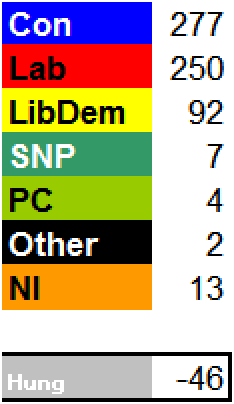
Your Current Forecast


Why not play along with our seat-by-seat forecast? It works like this...

Friday, 15 January 2010

Introducing a New Graph...


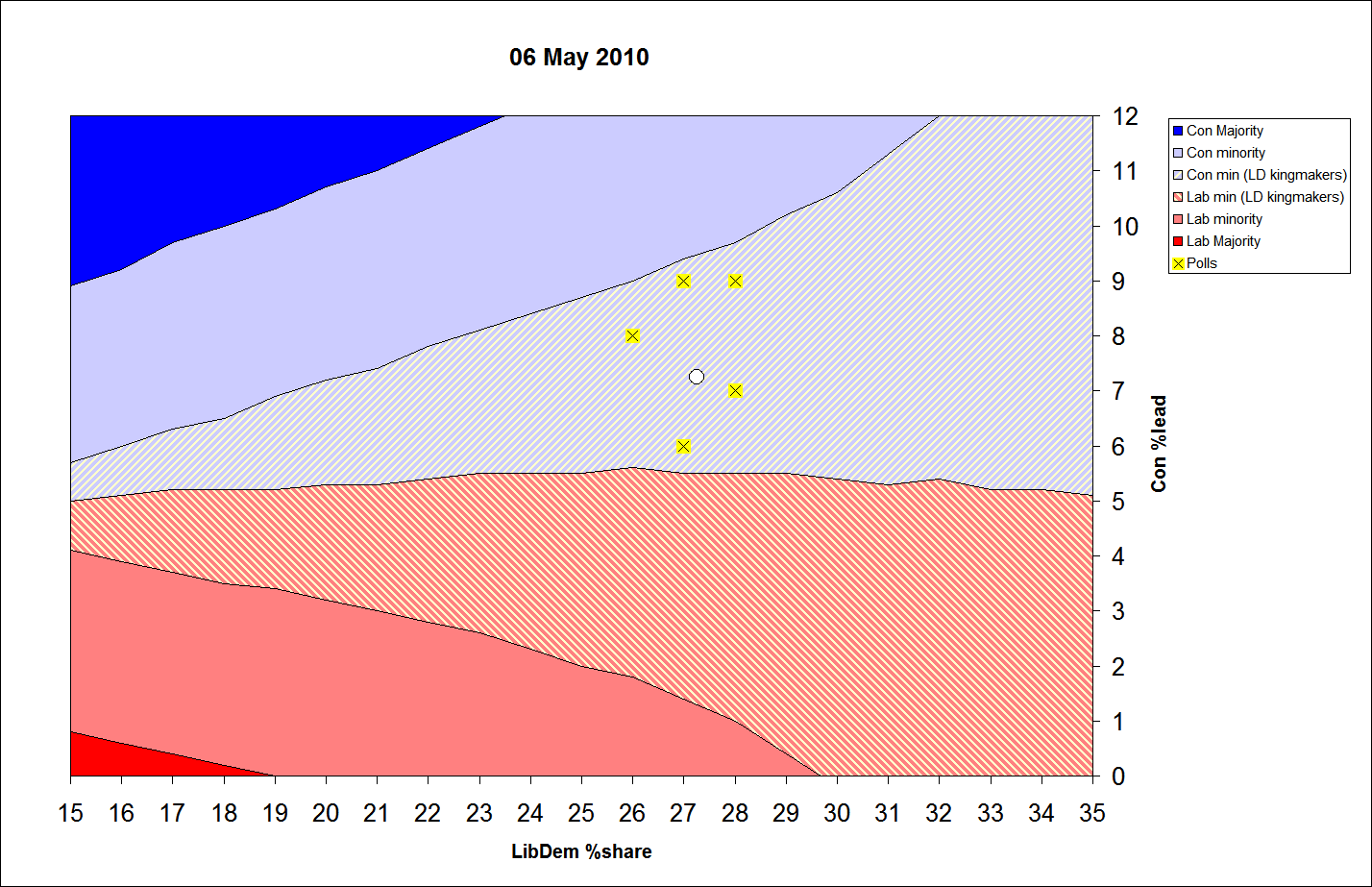
Following on from the PB article in 2006, I have now refined the Battleground Graph to show the best visual estimate of election outcomes.

The differences are small but can be summarised as follows.

Tuesday, 5 January 2010

Hung Parliament Revisited

The Channel 4 report touched on two points that were mentioned in an article I wrote for PoliticalBetting Channel 2 in April 2009. Here it is reproduced in full, updated slightly to take account of the latest data.


Discussions of the prospect of a hung parliament have probably caused more disagreements here than any other topic. The preponderance of opinion seems to be that the Tories are very likely to win a majority. All things are possible, but before one commits to a position an objective analysis is called for.

What is the Electoral System saying?
The capacity of FPTP to deliver an overall majority is entirely dependent on two factors – its exaggeration when translating votes into seats, and the number of third party MPs.

The first has been in long-term decline since the demise of the “cube-law” in the 1950s, although it has recovered slightly since 1992, and has now stabilised at around a “square-law.” This change, due to the decline in the number of marginals, means that fewer seats now change hands between Labour and Conservative for a given shift in votes, or swing.

The second has seen the number of MPs not aligned with Labour or Conservative grow from just 8 in 1955 to no fewer than 92 in 2005. This change, due to the rise in the LibDems and Nationalists, and the de-coupling of Northern Ireland from the mainland party system, means that to gain an overall majority Labour or Conservative now need a far larger lead in seats over each other than they did in the past.


Combined, these two factors have dramatically altered the British FPTP system from one where hung parliaments were extremely unlikely to one where they are now increasingly likely.
Thursday, 10 December 2009

What can we learn from Last Time?


On the last day of February 1974 the country went to the polls. It was a bizarre election...

A three-day week, power cuts, a miners' strike and the worsening situation in Northern Ireland had led Ted Heath to call an early election on the issue of "Who governs Britain?", against a backdrop of Liberal and SNP electoral resurgence.

In response to Heath's fatuous question, amid rain and snow in many parts of the country, the electorate delivered an impenetrable answer.


Seats chg Votes chg
Con 296 -37 37.9% -8.5
Lab 301 +20 37.2% -5.9
Lib 14 +8 19.3% +11.8
SNP 7 +6 2.0% +0.9
UU 7 -1 0.7%
Oth (NI) 5 +1 1.3%
PC 2 +2 0.5% -0.1
Oth (GB) 2 +1 1.1%
Speaker 1 -

(seat changes based on notional 1970 result)

The Tories emerged from the election with the most votes, Labour with the most seats, although had the seven Ulster Unionists remained fully-fledged affiliates of the Conservative party (as they were in 1970), Heath could have legitimately claimed a seat plurality as well. The Liberals, with over 6 million votes, had insufficient seats to combine with either main party to form a majority (318 seats required).

Sunday, 29 November 2009

The Hung Parliament that never was... [at least, not until later]


Can't see video? click here

Us old hands will remember the 1992 election, when almost all the polls pointed to a hung parliament, and even the network exit polls confirmed it. As the night wore on, the Tory projection increased, and the Conservatives were ultimately returned with an overall majority of 21, which, as it happened, proved insufficient to last through the parliament.

1992 is remembered now for being the "Waterloo of the Polls", and less for its real significance - the emergence of a strong anti-Tory bias in the electoral system, which has increased markedly since that date.

John Major's majority rested on just 1241 votes across 11 constituencies. Another 0.5% swing, and Labour probably would have forced a hung parliament.

Although virtually uncommented upon at the time, the electoral system had shifted dramatically in Labour's favour, and continued moving in the same direction at the two subsequent elections.
Reblog this post [with Zemanta]

A topical new blog....

This is a new blog on the prospect of a hung parliament at the next UK general election, which will be held before June 2010, and the consequences of such an outcome.

To avoid a hung parliament, the Conservative Party requires a larger swing and a larger turnover in seats than they have obtained at any general election since 1931.

The last hung parliament in the UK was in February 1974, and they also occurred in 1929, 1923 and twice in 1910. They were also narrowly avoided in 1992, October 1974, 1964, 1951 and 1950.

It looks quite likely that there will be another in 2010. There are good reasons for believing this, which we hope to explore here further....